
𝘣𝘺 𝘐𝘳𝘪𝘴 𝘈𝘯𝘯𝘦 𝘖𝘭𝘪𝘷𝘦𝘳𝘰𝘯
In a world where knowledge is power, research and innovation are the engines that drive academic institutions toward excellence and recognition. For a thriving local college like Abuyog Community College (ACC), limitations in resources, manpower, and experience are undeniable. Yet, these same constraints can serve as powerful springboards—if met with the right vision and strategic partnerships.
The recent benchmarking activity at Visayas State University’s (Baybay City, Leyte) Research and Development Office last April 2, 2025, served not just as an eye-opener but as a call to action for ACC administration and research council.
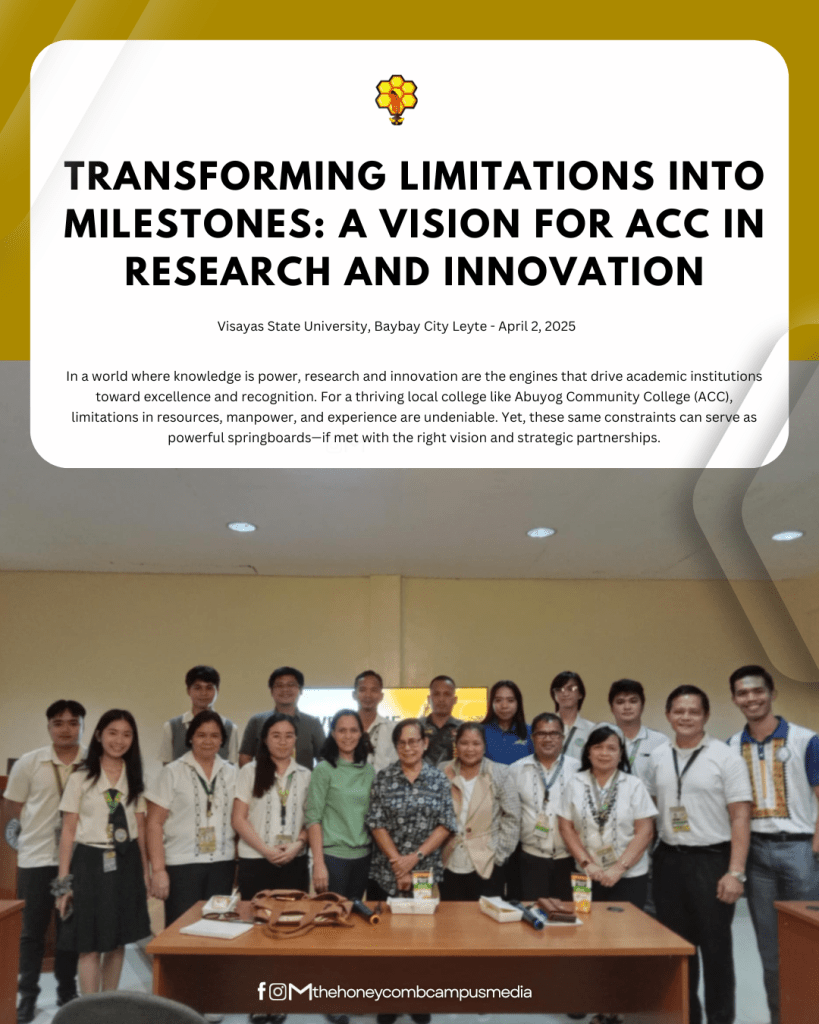
The Visayas State University, recognized for its strong research culture and CHED-accredited programs, exemplifies what is possible when institutional priorities align with national and global academic standards.
VSU stands as a recognized leader in research, with over 1,256 academic publications focused on agriculture and societal development.
ACC’s exposure to VSU’s best practices illuminated the necessity of embedding research into the very DNA of the institution. CHED’s standards, after all, emphasize not only instruction and extension but also a robust research agenda as a core pillar for institutional recognition and program accreditation. Meeting these standards requires more than compliance—it demands innovation, relevance, and sustainable practices.
But how can a local college like ACC transform its limitations into milestones?
Firstly, ACC can begin by investing in faculty development, encouraging research mentorships, and cultivating interdisciplinary collaboration. The recent benchmarking showed that even modest research programs can thrive when guided by committed leadership and continuous training.
Furthermore, rather than replicating large-scale research, ACC can develop a niche by focusing on community-based studies that address local challenges. This relevance not only adds value to the municipality of Abuyog but also captures CHED’s emphasis on societal impact.
Additionally, strengthening partnerships with other local college and national agencies where open-door policy for collaboration sets a precedent. ACC can leverage this connection to engage in joint research projects, proposal writing, and technical training. Building a culture of research starts with partnerships that inspire and sustain growth.
Moreover, from creating an internal research office to integrating research subjects across programs, ACC must institutionalize research as a norm rather than an option. With CHED’s quality assurance framework in mind, each step towards systematization marks a milestone.
Lastly, every successful student thesis, faculty publication, or external grant secured must be viewed as a victory. These incremental achievements form the foundation of a long-term research legacy.
In fact, ACC has already achieved notable progress in research. Some faculty members have published studies internationally, like the works of Dr. Joel Comaling with his study entitled, “Addressing Mental Health Stigma and Ehancing Counseling Access in Community Colleges” in the International Journal of Research and Scientific Innovation (IJRIS).
While other faculty members have also gained opportunity to present research at national and international stages and attended research conferences — proudly representing the institution and its commitment to scholarly growth.
Abuyog Community College stands at a critical junction. The limitations it faces are real—but so is its potential.
The VSU benchmarking has planted a seed of possibility. With commitment, creativity, and collaboration, ACC can chart a path where limitations become launching pads, and where milestones are not just goals—but proof of transformation.